


Blog: The Myth of Zeus on Mount Juktas – The Mountain Where the Father of the Gods Sleeps
Somewhere between Heraklion and the vineyards of Archanes, a giant lies sleeping. Look at Mount Juktas (Giouchtas) from a distance and you will see it clearly: the ridgeline forms the profile of an enormous face turned to the sky – a forehead, a nose, a bearded chin, all carved by nature into the limestone. For thousands of years, Cretans have told the same story about that face. It belongs to Zeus, the father of the gods, resting forever on the island where his extraordinary story began.
Born in a Cave, Hidden from His Father
The myth of Zeus starts with a terrifying prophecy. Cronus, king of the Titans, learned that one of his children would overthrow him – so he swallowed each one at birth. Desperate to save her sixth child, his wife Rhea fled to Crete and gave birth in secret, hiding the infant Zeus deep inside a mountain cave. There, the baby god was nursed by the goat Amaltheia and guarded by the Kouretes, young warriors who clashed their bronze shields and danced loudly so that Cronus would never hear the child cry.
The plan worked. Zeus grew strong in the Cretan mountains, overthrew his father, freed his swallowed siblings and became ruler of Olympus. Crete, the island that protected him, remained sacred to him forever.
The God Who Died – A Secret Only Crete Dared to Tell
Here is where the Cretan version of the myth becomes truly unique. While the rest of ancient Greece worshipped Zeus as an immortal god who could never perish, the Cretans insisted on something shocking: their Zeus also died – and his tomb lies on the summit of Mount Juktas.
This claim scandalised the ancient world. How could the king of the gods have a grave? The philosopher Epimenides famously accused his fellow islanders of lying about it, giving birth to the legendary „Cretan paradox“ – all Cretans are liars, said the Cretan. Yet the locals never abandoned their story. For them, the myth carried a deeper meaning: like the vines and the wheat of their island, their god died and was reborn with the seasons. And the sleeping profile of Juktas was proof enough – the god was not gone, only resting in the heart of his homeland.
A Mountain Sacred for 4,000 Years
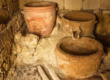
The legend did not appear from nowhere. Long before the ancient Greeks, Mount Juktas was one of the most important peak sanctuaries of the Minoan civilisation. Nearly 4,000 years ago, worshippers climbed to the summit to leave offerings to their gods – and the sanctuary stood in a direct line of sight from the great palace of Knossos below. When Greek mythology arrived, the sacred mountain simply received a new divine resident: Zeus himself.
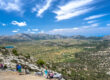
Even today the summit remains holy ground. A small chapel of Afentis Christos crowns the peak, continuing an unbroken chain of worship that stretches back to the Bronze Age, while the view sweeps over the Archanes vineyards, Heraklion and the endless blue of the Aegean.
See the Sleeping God with Your Own Eyes
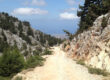
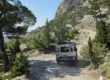
Myths survive in Crete because the landscape keeps them alive – and this one is best experienced from the dirt roads around the mountain itself. Our Tripiti Route makes its way towards Mount Juktas at the very start of the journey, offering breathtaking views of the sleeping profile and the Aegean Sea before continuing south through vineyards, villages and gorges. As our guides like to say, Zeus knew what he was doing when he chose this mountain as his final resting place.
Join us and discover the myth of Zeus on Mount Juktas. Book your Tripiti Route Safari with us.